

Over 40 Years of ENERGETAB. How a Bielsko-Biała Invention Exchange Became the Heart of Poland’s Energy Sector

Over 40 Years of ENERGETAB. How a Bielsko-Biała Invention Exchange Became the Heart of Poland’s Energy Sector
Some industry events are created with great ambition, major investment and a carefully planned marketing strategy. Others are born out of necessity - because spare parts are unavailable, foreign currency is scarce, and there is no obvious way to share a good technical solution in the economy of communist-era Poland. ENERGETAB in Bielsko-Biała belongs to the latter category.
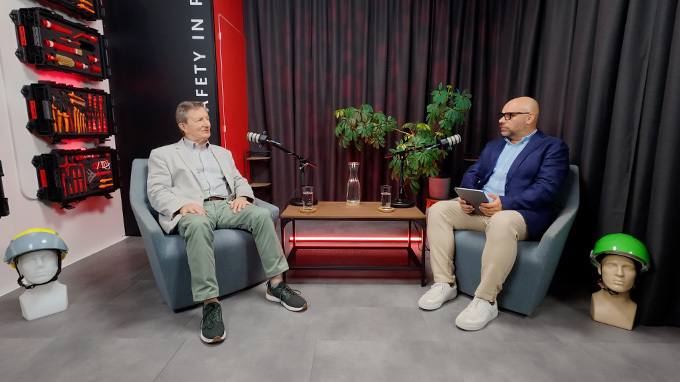
In the POD PRĄD podcast, Michał Włodarczyk talks to Ryszard Migdalski, a long-time Director of Trade Fairs and Training at ZIAD, about how a regional exchange of innovation projects grew into Poland’s largest gathering of the energy industry.
This story is worth reading alongside the earlier conversation “50 Years of Live-Line Work in Poland – A Conversation with a Man Who Was There from the Beginning,” in which Bogumił Dudek discussed the beginnings of live-line work (LLW) technology at the Gliwice Energy Company. The connection is not accidental - as Ryszard Migdalski recalls, the live-line work training ground in Bielsko-Biała was opened as early as 1976, and both the training and trade-fair stories developed at the same centre, in response to the same shortages: equipment, procedures and knowledge that could not simply be found on Google at the time.
An Exchange, Not a Trade Fair - The Beginning in the Shadow of Shortages in Communist Poland
In the 1970s, the Polish energy sector was divided into five districts. In Bielsko-Biała, the Centre for the Implementation of Technical Progress in the Energy Sector operated as a training facility under the Southern District Energy Company in Katowice.
In the difficult 1980s, when, as Ryszard Migdalski recalls, “it was very difficult to obtain any spare parts,” and the foreign currency needed to import equipment was in extremely short supply, the energy sector authorities came up with an unusual solution: an exchange for power-plant innovation and invention projects.
Power-plant employees presented solutions they had developed themselves - ideas designed to reduce dependence on imports and repair equipment that could not simply be purchased.
Fourteen exhibitors came to the first edition. The displays - as Migdalski admits - “looked rather funny,” consisting mainly of tables with documentation and individual models. However, the level of interest proved strong enough that two years later the exchange was held again, this time for the entire energy sector rather than just the power-generation industry. From then on, the event was held every two years.
Bielsko-Biała as Poland’s School of French Energy Expertise
Why Bielsko-Biała?
At the time, the centre was the main training location for Poland’s entire energy sector. From 1974 onwards, trainees came here to work with simulators and laboratories, while the hotel and conference facilities made it possible to organise large-scale events.
Interestingly, the centre was developed based on the model of training centres operated by French EDF, a company that was intensively developing nuclear power plants in the 1970s and needed a well-trained, highly qualified workforce.
Migdalski jokingly explains this close connection with the saying, “your best friend is the country next door,” and admits that the biography of Edward Gierek may also have played a role - before becoming First Secretary of the Polish United Workers’ Party, Gierek had spent part of his life in France.
It was at the Bielsko-Biała centre that Poland’s first computer simulator for training dispatchers was developed, based on the Odra 1225 computer. Another simulator was also created for a 200-megawatt power unit – a considerably more technically challenging project, as the computers available at the time could not keep up with the thermal processes involved.
The Live-Line Work Training Ground That Changed the Rules of the Game
In 1976, a live-line work training ground was opened in Bielsko-Biała - the second location in Poland, alongside Dzierżno near Gliwice, where this technology was being developed.
While the centre in Dzierżno, associated with Bogumił Dudek, focused primarily on testing and developing the technology itself, the Bielsko-Biała training ground was built from the outset with the training of electrical crews in mind.
Migdalski recalls that for many electrical workers, live-line work was essentially the formal recognition of something they had already been doing “somewhat half-legally” on a daily basis. Now they could learn the relevant regulations and carry out this work safely and legally.
Another breakthrough was the emergence of Polish live-line work tools manufactured by HUBIX, which replaced expensive equipment imported from France. The cooperation was so close that for many years trainees completing their training in Bielsko-Biała left with a complete set of HUBIX tools.
The results of this cooperation were also reflected in awards received at the trade fair: the Minister’s Cup awarded to HUBIX in 2006 and 2010, as well as the Kazimierz Szpotański Golden Lion, awarded in 2003 for a product with a significant Polish contribution to its design.
Capitalism Enters the Exchange
The transition from the 1980s to the 1990s fundamentally changed the character of the event.
The legislation opening up the market led to the emergence of small private workshops. According to Migdalski, these companies were among the first to try to present their products at the exchange because they knew that potential customers were coming there.
Without the internet, the only way to reach energy professionals from across Poland was through face-to-face meetings and word-of-mouth recommendations.
Western companies soon joined as well. They were looking not only for customers, but also for local representatives. Some of them, including ABB and Siemens, established Polish branches as early as the following year. This forced the organisers to introduce a separate category for “international companies,” because formally these businesses were no longer foreign companies operating in Poland.
Why Not Poznań?
At the time, the International Poznań Fair already dominated Poland’s trade-fair landscape and was often referred to as the country’s “window to the world.”
Migdalski does not hide the fact that Bielsko-Biała cooperated closely with Poznań, but it chose a different path: a narrow industry specialisation instead of a universal exhibition where, as he puts it, “you could see a nice bent chair, a new Fiat and some other equipment.”
Bielsko-Biała’s advantage was that its visitors - participants of training courses and earlier exchanges - already knew the location and kept returning with specific, industry-related needs.
From an Exchange to ENERGETAB
The word “trade fair” was not adopted until 1996. A year earlier, the event still operated under the hybrid name “trade fair - former exchange.”
The acronym ENERGETAB was created from the full name Energetyczne Targi Bielskie - Bielsko Energy Fair - developed during the work of the Programme Council. As Migdalski explains, the name Międzynarodowe Bielskie Targi Energetyczne - International Bielsko Energy Fair - was simply too long for everyday use.
For many years, a spring IT event called Info Energetab was also organised, focusing on the computerisation of the energy sector. It was eventually taken over by the Polish Power Transmission and Distribution Association.
Restructuring That Taught the Company to Stand on Several Legs
The success of the trade fair went hand in hand with the turbulent history of the company itself.
At its peak, ZIAD employed around 500 people in Bielsko-Biała, Katowice and a small branch in Kraków.
The economic transformation broke up the structure of the energy sector into separate companies, and the ownership of the centre also changed. Initially, it belonged to the Minister of the Treasury, then to the Bielsko Voivode, and after the abolition of the voivodeship, to the City of Bielsko-Biała, which became the company’s local owner.
Today, ZIAD employs fewer than one hundred people, but has diversified its operations, including through its tourism business.
Ryszard Migdalski himself, who had been associated with the company since 1973, served as its president and later spent many years as Director of Trade Fairs and Training. He remained in this position until 2017, when he retired. To this day, he continues to visit the company as an adviser and share his experience.
A Scale Unmatched by Other Industry Trade Fairs
The most dynamic growth took place around the turn of the 1990s and 2000s.
The record-breaking edition in 2016 brought together 768 exhibitors across an area of almost four hectares, with parking for around 500 cars.
To help visitors navigate hundreds of stands, ZIAD has for years published an industry index in the trade-fair catalogue, dividing the exhibition into nearly ninety product categories. Today, the index is also available online, with navigation showing the exact location of each stand.
One interesting tradition is something Migdalski says he has not encountered at other international events: long-standing exhibitors automatically receive the same location at the fairgrounds as in previous years. For many companies, this has become an important part of their identity at ENERGETAB.
Another breakthrough came in 2010, when a new exhibition hall was opened. It helped organise the site and, equally importantly, solved power-supply problems that had once been so serious that an energy trade fair could actually open without electricity.
From Fourteen Tables to Almost 800 Exhibitors
The history of ENERGETAB shows that major industry events rarely emerge from a ready-made plan. More often, they grow out of a specific problem that needs to be solved: a shortage of spare parts, a lack of a place to exchange experience, or a lack of a common language between manufacturers and energy professionals.
From fourteen exhibitors sitting at tables with technical documentation to almost 800 companies spread across four hectares - this is the journey that Ryszard Migdalski witnessed from the inside for more than half a century.
If you want to discover the full story of ENERGETAB, watch the first part of the POD PRĄD podcast with Ryszard Migdalski.
In the second part:” Over 40 Years of ENERGETAB. How a Bielsko-Biała Invention Exchange Became the Heart of Poland’s Energy Sector" , Michał Włodarczyk explores whether the trade fair has successfully reinvented itself after the pandemic and what the future holds for ENERGETAB.