


How Has Live-Line Working Evolved in Poland? Stanisław Płuciennik on People, Technology and the History of the Power Industry

Live-line working is now one of the methods used to maintain and service electricity networks, allowing specific tasks to be carried out without interrupting the power supply. However, before this technology began to develop on a larger scale, years of experience, the search for suitable solutions, training and efforts to convince people that work could be carried out differently were needed.
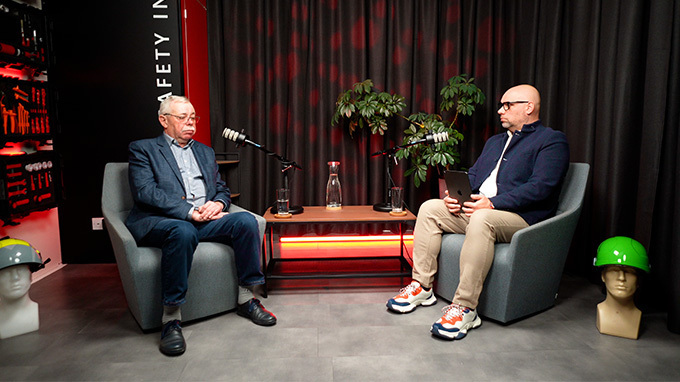
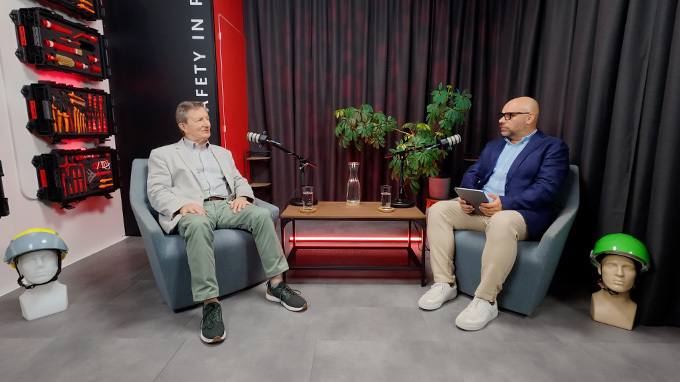
In the latest episode of the “Pod Prąd” podcast, Michał Włodarczyk talks to Stanisław Płuciennik, a retired employee of PGE Dystrybucja’s Łódź branch, who spent many years contributing to the development of live-line working in Poland.
It is a story about the early days of this technology, the first attempts to introduce it on medium-voltage lines, experience gained from working on 400 kV lines, and cooperation with international specialists. It is also a story about how attitudes towards safety have changed, why new methods are not always readily accepted, and what remains of the legacy of someone who spent decades developing their field.
The history of live-line working in Poland is also the story of the people who laid the foundations for this technology and developed safety standards over the decades. The early days of live-line working, the first procedures and the development of a training system are also discussed by Bogumił Dudek, one of the pioneers of live-line working in Poland, in “50 Years of Live-Line Working in Poland – A Conversation with Someone Who Was There from the Beginning
From Electrical Technician to Technology Developer
Stanisław Płuciennik began his professional career in 1976. For the first ten years, he worked as an electrical technician at Łódź University of Technology while studying part-time in the Faculty of Electrical Engineering.
In 1986, he moved into the power industry, joining the Łódź-Teren Power Utility. He was soon entrusted with responsibilities related to coordinating live-line work. However, this was not an area he already knew inside out. He had to quickly familiarise himself with existing solutions, understand the principles behind them and take responsibility for developing this field within the utility.
His previous experience as an electrical technician proved particularly valuable. It enabled him to look at the technology not only from the perspective of instructions and documentation, but also through the eyes of someone carrying out the work in the field.
The power industry fascinated him so much that he continued his education while working, including completing postgraduate studies related to renewable energy. During the conversation, he also recalls how his responsibilities, professional relationships and perspective on the industry evolved over time.
Today, following his retirement, he remains connected to the power industry through the people he worked with over the years and the experience he can share with others.
Live-Line Working: Between Experience and New Technology
The development of live-line working was not a straightforward transition from one method to another. It required changes in established habits, the preparation of suitable equipment and a clear understanding of the conditions under which specific tasks could be carried out safely.
Mr Płuciennik admits that he was initially somewhat sceptical about the technology. On the low-voltage networks of the time, carrying out a particular task on an energised line could take longer than performing it after the power supply had been disconnected. However, this comparison could easily overlook the time required to prepare the worksite and carry out the shutdown itself.
Despite these doubts, he recognised the value of developing the method. The key was to convince both himself and other employees that new solutions could be worthwhile if they were properly prepared and implemented.
Support from management played an important role. Włodzimierz Wondołowski, the utility’s technical director at the time, supported the development of this area. This made it possible to continue the work and gradually expand its scope.
This history demonstrates that implementing new technology involves much more than purchasing tools or equipment. It also requires knowledge, experience, organisational support and a willingness to reassess established practices.
Extra-High-Voltage Lines and Experience from the 1980s and 1990s
One of the lesser-known topics discussed in the podcast is the history of crews trained to work on extra-high-voltage lines.
As Mr Płuciennik recalls, around nine or ten such crews operated in Poland, working on 400 kV lines. Developing this technology required access to suitable equipment, preparing personnel and acquiring knowledge from other countries.
During the 1980s and around the turn of the 1990s, Poland drew, among other things, on Hungarian experience and solutions developed in the former German Democratic Republic. These technologies were used for tasks including insulator replacement and the maintenance of transmission lines.
Preparing the crews involved much more than providing instructions. Training, practical mastery of the methods and appropriate equipment were all essential to carrying out specific tasks under high-voltage conditions.
Subsequent organisational changes in the power industry influenced the further development of this field. Mr Płuciennik points out that not all initiatives progressed as originally intended.
This is an important part of the history of live-line working: a technology may be available and teams may be trained, but its continued use also depends on organisational decisions, funding and a consistent commitment to implementing adopted plans.
How Was Technology for Medium-Voltage Lines Selected?
A particularly important stage was the development of live-line working on overhead medium-voltage lines. During the conversation, Mr Płuciennik looks back at initiatives undertaken in the mid-1990s, when a team associated with the Polish Association of Transmission and Distribution of Electricity (PTPiREE) identified the need to organise and further develop this area.
One of the challenges was to standardise the instructions used by different utilities. Individual companies had developed their own solutions and documentation, making a common approach to establishing working procedures necessary.
At the same time, efforts were made to identify technology suitable for Poland’s overhead medium-voltage networks. To this end, solutions used abroad were examined, including those in France, Ireland and England.
Members of the team travelled overseas to observe these methods in practice. The Irish approach attracted particular interest because it used an elevating platform with an insulated boom.
The aim, however, was not to transfer an existing solution to Poland without further assessment. Its suitability had to be evaluated, differences in network construction taken into account, and procedures developed to meet Polish conditions.
Implementation therefore required a combination of knowledge gained abroad and the experience of Polish power engineers. At this stage, training, the preparation of documentation and practical verification of the proposed solutions became especially important.
Irish Experience and Polish Conditions
Mr Płuciennik’s first direct encounter with the technology used by Irish specialists came as a surprise. The solution first had to be observed, understood and assessed in terms of its potential application in the Polish power industry.
Once this approach had been selected, preparations for implementation began. Irish specialists travelled to Poland to provide training, with participants subsequently expected to pass their knowledge on to other employees.
Working instructions were developed in parallel. This was essential because similarities between technologies did not mean that identical procedures could be applied without accounting for differences in network design.
Three elements came together at this stage: international experience, the expertise of Polish specialists and the practical preparation of personnel for their new tasks.
It was not enough to learn how to operate the equipment. Employees also needed to understand the principles behind the entire system, the safety requirements and the correct procedures for specific working conditions.
Implementing the technology was therefore a process that involved far more than purchasing equipment. Its success also depended on training, instructions, work organisation and the willingness to pass knowledge on to others.
Safety Is About More Than Equipment
Live-line working requires thorough preparation because mistakes can have serious consequences. The conversation touches on experience with electrical hazards and the importance of understanding the principles governing individual tasks.
Michał Włodarczyk recalls an experience during a training session when an elevating platform began to rise. Despite his knowledge of the technology and previous exposure to the industry, he experienced a moment of doubt. It was a very human reaction, illustrating that even theoretical preparation does not necessarily eliminate every concern.
In such situations, what matters is not simply being reassured that everything will be fine, but understanding how the technology and its safety systems work. Knowledge, appropriate equipment, proper procedures and employee training must form a coherent system.
Mr Płuciennik also emphasises the importance of practical experience. He does not define competence solely by job title or professional background. Openness to learning, awareness of hazards and a willingness to use solutions that help make work safer are equally important.
This is particularly significant in a field where improvisation has no place and every technology must be used as intended and in accordance with established procedures.
Why Do Some Technologies Develop Differently from Others?
The history of live-line working also shows that implementing a solution does not guarantee its continued development. Progress requires consistency, organisational support and a commitment to investing in people and equipment.
Mr Płuciennik recalls changes in the power industry and notes that not every initiative delivered the results originally expected. Some crews trained to carry out specific tasks did not go on to operate on the scale initially envisaged.
At the same time, live-line working gradually became more important because it made it possible to carry out certain tasks without disconnecting the power supply. As networks developed and customer expectations changed, solutions that helped reduce power interruptions became increasingly valuable.
This does not mean that shutdowns can or should always be replaced by live-line working. Every method requires an assessment of the conditions, the scope of the work and the associated safety considerations. Nevertheless, the story illustrates how operational needs can drive technological development.
What Remains After Decades of Work?
Stanisław Płuciennik spent several decades in professional employment and retired after preparing for a change in his daily routine. As he explains, work responsibilities gave way to other activities, but his relationships with colleagues and his connection to the power industry have not disappeared entirely.
Towards the end of the conversation, he reflects on what remains after someone has spent years developing a particular field. Mr Płuciennik speaks about laying foundations that others can continue to build on and the importance of passing experience on to the next generation.
This is an important message for the modern power industry as well. Technologies change, organisations undergo successive transformations and network requirements evolve. Yet the knowledge gained by those who participated in the early development of specific solutions remains a valuable point of reference.
The history of live-line working is not just a story about equipment and instructions. It is also a story about cooperation, decision-making, overcoming concerns and gradually building expertise.
A History That Still Matters
The conversation with Mr Płuciennik is a reminder that technological development in the power industry does not happen overnight. It requires the search for solutions, learning from others, adapting methods to local conditions and preparing the people who will use them.
The introduction of live-line working on medium-voltage lines was one stage in this journey. It was made possible by international experience, the work of specialist teams, training and efforts to address specific operational needs.
Not every plan was realised on the scale originally anticipated. Nevertheless, valuable experience was gained, and the knowledge accumulated along the way is worth revisiting and passing on.
Because in the power industry, technology matters — but so do the people who know how to develop it, understand it and teach others to use it.