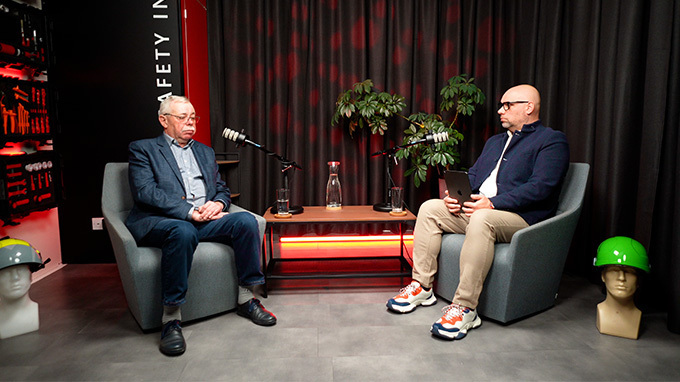



50 Years of Live Work in Poland – A Conversation with a Man Who Was There from the Beginning

50 Years of Live-Line Work in Poland – A Conversation with One of the People Who Helped Shape Its History
Some people leave a lasting mark on an industry—not because they developed a single innovation or took part in one significant project, but because they helped shape the direction of an entire field.
One such person is Bogumił Dudek, a true pioneer of live-line work in Poland who has dedicated more than fifty years to improving safety in the power industry.
To mark the 50th anniversary of live-line work (LLW) in Poland, we invited him to the POD PRĄD Podcast to talk not only about the history of live-line technologies, but also about the people, decisions, and experiences that helped shape today's power sector.
Before There Were Standards
Today, it is difficult to imagine the power industry without established procedures, certified protective equipment, or comprehensive training systems.
But it wasn't always that way.
As Bogumił Dudek recalls, in the 1970s the challenge was not only the lack of live-line technologies. In many cases, even the most basic protective equipment—now considered standard for every lineworker—simply did not exist.
At the time, Poland's power industry was expanding rapidly, and maintaining a reliable electricity supply was becoming increasingly important. At the same time, it became clear that occupational safety had to become one of the fundamental pillars of the industry.
This was the beginning of the first efforts to develop a systematic approach to live-line work.
1975 – The Beginning of a New Chapter
Although isolated live-line operations had been carried out earlier, 1975 is widely regarded as the symbolic beginning of modern live-line work in Poland.
It marked the launch of the first structured procedures, technical methods, and training programmes that made it possible to perform this type of work in a safe and organised manner.
As our guest explains, the real breakthrough was not simply performing work on energised equipment—it was creating an entire system that combined specialised tools, work organisation, technical supervision, and professional training.
That comprehensive approach became the foundation for the development of live-line technologies over the following decades.
Turning Theory into Practice
One of the most fascinating parts of the conversation focuses on the early training programmes and field implementations.
At a time when access to international technologies was extremely limited, Polish specialists built their expertise through technical literature, foreign publications, and their own practical observations.
The first training centres were established, specialised equipment continued to evolve, and more and more crews became qualified to perform live-line work.
It was a process that demanded not only technical knowledge, but also courage and determination from those who believed that worker safety and uninterrupted power supply could successfully go hand in hand.
Safety Never Happens by Accident
One of the most important messages from the interview is that today's safety standards did not emerge overnight.
Every procedure, every insulated tool, and every industry standard exists because dedicated professionals spent decades developing, testing, refining, and improving them—often through experience gained by trial and error.
The history of live-line work is also the history of continuously reducing risk and raising safety standards for those working in the field.
As a result, a technique that once seemed highly controversial has become one of the essential pillars of modern power distribution.
Why You Should Watch This Episode
This conversation is not only for professionals involved in live-line work.
It is a story about the development of Poland's power industry, the growth of technical expertise, the importance of safety culture, and the people who had the vision and determination to introduce solutions that were ahead of their time.
As we celebrate 50 years of live-line work in Poland, there is no better opportunity to revisit its origins and hear the story from someone who witnessed—and helped shape—it from the very beginning.
We invite you to watch the latest episode of the POD PRĄD Podcast featuring Bogumił Dudek.
Watch the full episode below:
Want to Learn Even More About the History That Shaped Poland's Power Industry?
A perfect companion to this fascinating conversation is our special anniversary episode recorded to celebrate the birthday of Jerzy Nowikow, the founder of HUBIX.
In the episode titled "You Can't Build a Great Product Behind a Desk," we travel back to the early days of live-line work in Poland. Discover how protective equipment was designed and tested in real field conditions, the challenges faced by a young engineering team, and how the groundbreaking SECRA range of electrically insulating safety helmets came to life.
Discover the unique memories of the man who helped transform electrical safety in Poland's power industry.
Click here to watch this special podcast episode on our blog!
If you'd like to see how this story continued in the years that followed, we also invite you to read our article celebrating 20 years of SECRA and featuring an interview with Robert Nader
It explores what happens after the initial concept becomes a product-from PPE certification and arc flash testing to the evolution of international safety standards and the continuous development of a helmet that, in real working conditions, can make the difference between life and death.