


20 Years of SECRA. Certification Is Only the Beginning...

20 Years of SECRA. Certification Is Only the Beginning. How Is a Helmet That Protects Human Lives Really Made?
Some products reveal their quality the very first time they are used. Others hide their true value beneath the surface. Electrically insulating helmets belong to the latter category.
What users see is a comfortable helmet with an integrated face shield, ergonomic adjustment and a well-balanced design. What they don't see are hundreds of hours of engineering, countless laboratory tests, technical documentation spanning hundreds of pages, and a certification process that takes months to complete.
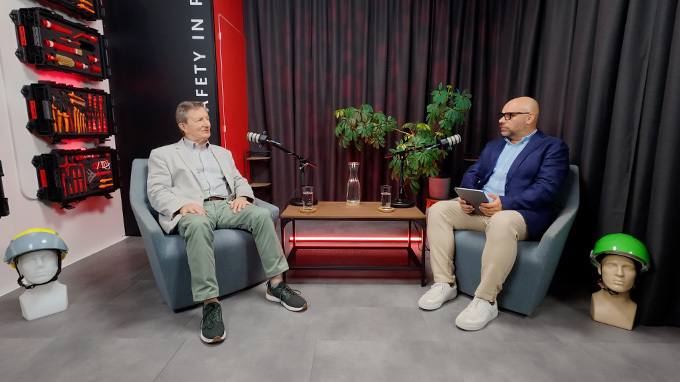
In the latest anniversary episode of our "Pod Prąd" (Live-Line) podcast, released to celebrate the 20th anniversary of the SECRA brand , Robert Nader explains why safety begins long before a worker steps onto the job site.
This episode is best understood as the third chapter of a broader story.
In the interview "50 Years of Live-Line Work in Poland – A Conversation with Someone Who Was There from the Very Beginning," Bogumił Dudek explained that the development of live-line work (LLW) in Poland since 1975 has never been limited to performing maintenance on energized equipment. It has been about building an entire ecosystem of procedures, specialized equipment, training programs and technical supervision.
Earlier, in the podcast "You Can't Build a Great Product from Behind a Desk," recorded to celebrate the birthday of HUBIX founder Jerzy Nowikow, we explored the philosophy that has shaped the company for decades: truly effective protective equipment is created through close cooperation with its users, extensive field experience and the belief that every technical challenge is simply another problem waiting to be solved.
Certification Is More Than Just a Piece of Paper
Many people assume that certification simply means sending a product to a laboratory, carrying out several tests and receiving an official certificate.
The reality is far more complex.
As Robert Nader explains, "Certification is much more than simply verifying whether a product complies with a standard." A laboratory test report is only one element of a much broader process.
Before a product can be placed on the market as Category III Personal Protective Equipment (PPE), the manufacturer must demonstrate compliance with the requirements of Regulation (EU) 2016/425 of the European Parliament and of the Council.
This requires comprehensive technical documentation covering every stage of the product's development—from material specifications and risk assessment, through manufacturing processes and user instructions, to component documentation, test reports issued by accredited laboratories, and conformity assessment performed by a notified body.
The CE Mark Does Not Simply Mean "Safe"
The same misconception often applies to the CE marking. It is commonly associated with a general guarantee of safety, while in reality it has a much more specific meaning.
As Robert Nader explains, "The CE mark simply means that the product has successfully passed the conformity assessment process." In the case of Category III Personal Protective Equipment (PPE), the CE marking must also be accompanied by the identification number of the Notified Body responsible for ongoing conformity assessment and production surveillance.
This distinction is crucial.
A product is only safe when it is used for its intended purpose, in accordance with the manufacturer's instructions and under the conditions for which it was designed and tested.
Certification is therefore not the end of the story. It is a formal confirmation that the product has successfully passed a rigorous conformity assessment process. Its true value, however, becomes evident only when it is used correctly in real working conditions.
When SECRA Was Created, There Were No Ready-Made Solutions
Today, an electrically insulating helmet with an integrated face shield seems like an obvious solution.
However, when development of the first SECRA began , the market looked completely different. Only a handful of similar products existed worldwide, and the relevant standards were still in their infancy.
This meant combining the requirements for an industrial safety helmet and a face shield into a single, entirely new product.
This context perfectly complements our earlier conversation about the beginnings of live-line work in Poland. Before innovative protective equipment could be developed, the industry first had to establish the technology, procedures and safety culture that would define modern live-line operations.
For the HUBIX team, this was the company's first certification project of such complexity.
Moreover, it was also the first project of its kind for the Notified Body responsible for carrying out the conformity assessment.
Although it would have been possible to certify the helmet and the face shield separately, HUBIX deliberately chose the more demanding approach.
As Robert Nader explains:
"We certified it as one complete product."
Even the Laboratory Had to Adapt
Before the SECRA project began, the HUBIX laboratory specialised primarily in testing equipment used for live-line work.
Most of its activities focused on dielectric testing.
Developing an electrically insulating helmet introduced an entirely new set of challenges, including mechanical testing, impact resistance, shock absorption, conditioning under extreme temperatures and accelerated ageing of materials.
Several test rigs had to be designed and built specifically for this project.
As a result, developing the product also meant expanding the company's own testing capabilities and technological infrastructure—one of the less visible, yet essential, chapters in the SECRA story.
This stage also demonstrated that laboratory testing is not always the greatest challenge.
In many cases, compiling complete technical documentation can be equally demanding—especially when a product consists of components supplied by multiple manufacturers, each requiring proper documentation, traceability and verification as part of the conformity assessment process.
The Ultimate Test? Arc Flash
One of the most significant milestones in the history of SECRA was the first series of face shield tests evaluating resistance to arc flash.
In the early days, manufacturers often assessed the protective performance of face shields primarily based on their thickness and the materials they were made from. During presentations, Robert Nader recalls joking that face shields used to be tested with "a caliper."
It quickly became clear, however, that this approach was far from sufficient. What the industry needed were test methods capable of replicating real-world hazards.
During a Box Test, a specially designed laboratory setup generates a controlled electric arc, while sensors mounted on a headform measure the amount of thermal energy reaching the wearer's face. This allows engineers to determine whether the face shield can effectively protect against severe thermal injuries caused by an arc flash.
The first attempts to achieve Class 2 performance were unsuccessful. Subsequent testing, however, confirmed compliance with Class 1 requirements—with a significant safety margin.
Standards Continue to Evolve
Safety is never a fixed destination—and neither are the standards designed to ensure it.
Since the launch of the first SECRA, testing methods, certification requirements and approaches to evaluating arc flash protection have continued to evolve.
As Robert Nader points out,
"Standards are always one step behind products."
Innovation comes first. Standards follow.
Today, professionals are increasingly familiar with terms such as Box Test, Open Arc, ATPV and ELIM.
While the Box Test classifies face shields into protection classes, the Open Arc method provides quantitative performance values based on the thermal energy transmitted to the user.
ATPV (Arc Thermal Performance Value) defines the incident energy level at which there is a 50% probability of preventing a second-degree burn.
ELIM (Incident Energy Limit) is an even more conservative parameter, representing the energy level below which the probability of a second-degree burn is considered negligible.
As Robert Nader explains,
"ATPV represents the probability of sustaining a second-degree burn, whereas ELIM represents virtually zero probability."
Arc Flash Is Not a Hazard You Can Measure with a Simple Instrument
Determining electrical voltage is relatively straightforward. Once the nominal voltage is known, appropriate protective equipment can be selected.
Arc flash risk assessment is far more complex.
As Robert Nader notes, there is no such thing as an "arc flash meter" capable of instantly determining the conditions that may occur during a fault.
Assessing the hazard requires a thorough understanding of the installation itself, including the power source, prospective fault energy, the worker's distance from the arc source and the work methods being used.
This illustrates an important principle:
Personal protective equipment is only one component of an effective safety system.
Equally important are risk assessment, proper work procedures and engineering measures designed to reduce fault energy wherever possible.
Certification Never Really Ends
Obtaining certification is not the final step in a product's lifecycle.
For Category III Personal Protective Equipment, certification marks the beginning of continuous surveillance.
Notified Bodies regularly audit manufacturing processes, review technical documentation and verify that production batches continue to comply with the approved design and applicable standards.
Any significant design modification may require a new conformity assessment—and, in some cases, an entirely new certification.
The standards also require products to undergo conditioning and accelerated ageing tests. Yet, as discussed in the podcast, no laboratory test can fully replicate years of everyday use.
Scratches, impacts, accidental knocks against structures and normal wear and tear are all part of a product's real working life.
That is why the development of SECRA does not end once certification has been obtained. It is an ongoing process of continuous improvement that lasts throughout the product's entire lifecycle.
The Best Testing Laboratory Is Still the End User
Although standards define hundreds of technical requirements, there is one aspect that can never be fully captured by regulations or laboratory testing: the everyday experience of those who use the equipment.
Ergonomics, comfort, adjustability and fit are all included in certification requirements, but the most valuable feedback always comes from the field.
When dozens of users identify the same issue—or suggest the same improvement—it becomes the starting point for the next stage of product development.
This idea connects all three anniversary conversations.
It links the story of 50 years of live-line work in Poland, Jerzy Nowikow's philosophy that "you can't build a great product from behind a desk," and Robert Nader's explanation of what certification truly involves.
Ultimately, every product evolves because of the people who rely on it every day.
Twenty Years of Experience Built into a Single Helmet
The story of SECRA demonstrates that truly innovative products are never created in isolation.
They are the result of close collaboration between engineers, testing laboratories, certification bodies and—most importantly—the professionals who use them in the field.
In that sense, the 20th anniversary of SECRA is part of a much larger story: one that begins with the pioneering days of live-line work in Poland, continues through the practical design philosophy developed at HUBIX, and extends to today's certification requirements and advanced arc flash testing methods.
Behind every certificate lie thousands of hours of engineering, testing and continuous refinement—all driven by a single goal.
As Robert Nader puts it:
"The most important thing is that every electrician returns home safely today, tomorrow, the day after tomorrow—and every day thereafter."
That simple statement perfectly reflects the philosophy behind SECRA and the mission that has guided HUBIX for decades.
If you would like to learn more about the certification process for personal protective equipment, discover how SECRA came to life , and understand why safety standards continue to evolve, we invite you to watch the full episode of the "Pod Prąd" (Live-Line) podcast featuring Robert Nader.
Watch the full episode: